Press Brake Backgauge Retrofit & Multi-Axis Upgrade Solutions

Precision Backgauge Reconstruction: The Foundation of Bending Accuracy

A high-performance CNC controller is only as effective as the mechanical system it commands. While a modern control system delivers precision to the beam, true repeatability and part accuracy depend entirely on the backgauge.

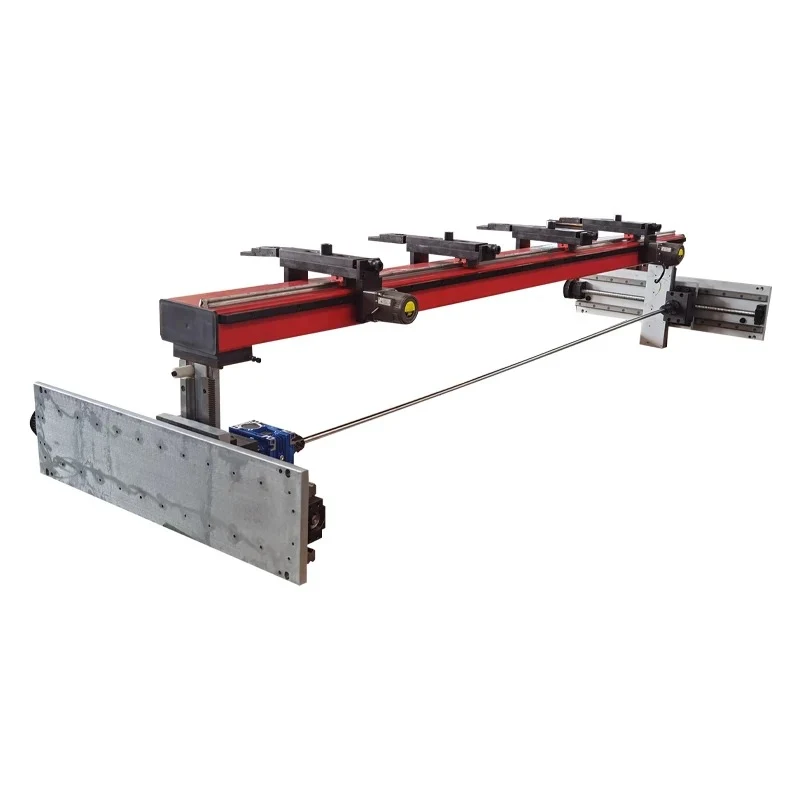
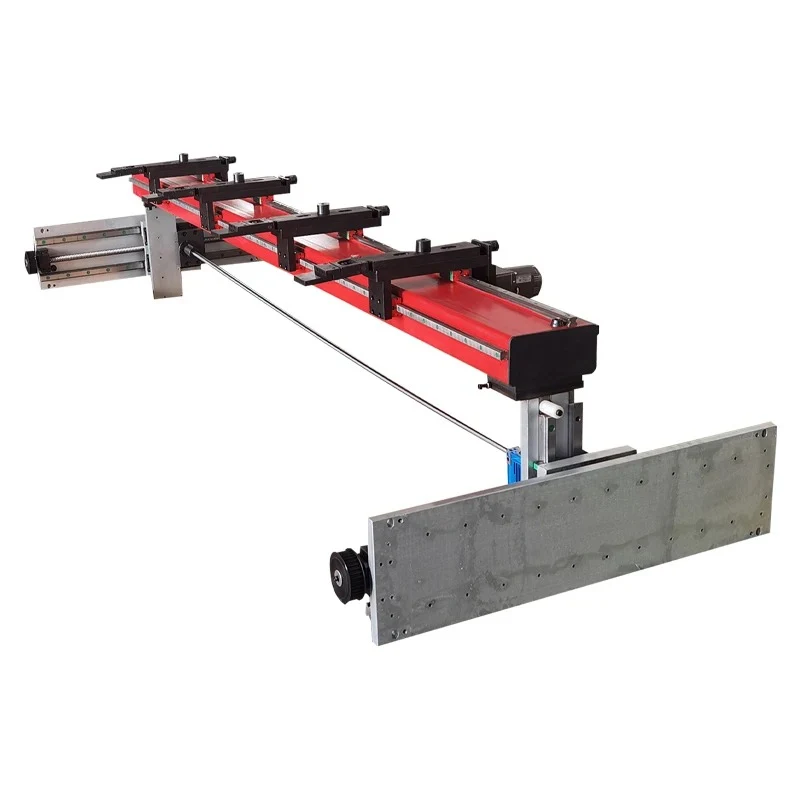
System 1 — X & R Axis (Upgradeable)

Core X–R backgauge with built-in structure for future Z1–Z2 and H1 upgrades. Scalable at any time.

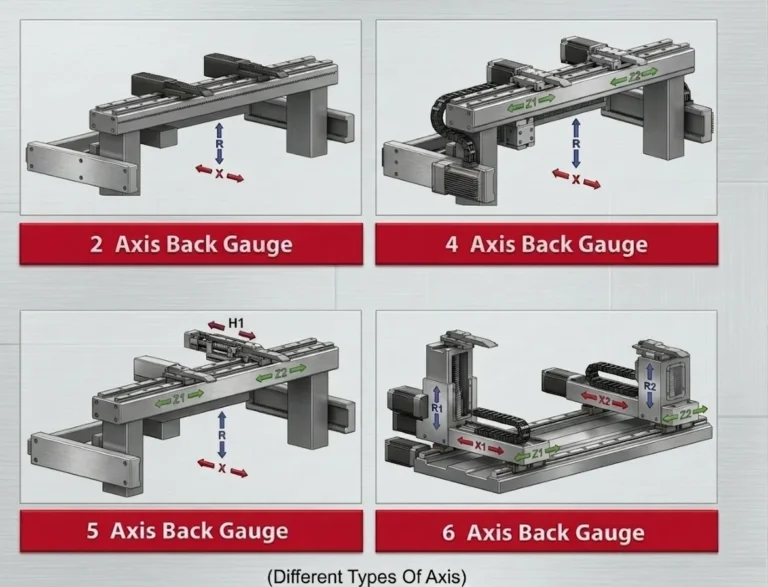
Press Brake Backgauge Axes Explained

X and R Axes — The Foundation of Precision

The fundamental axes of any professional press brake backgauge are X (Depth) and R (Height).

  • X-Axis: Controls the forward and backward positioning of the sheet for precise flange lengths.

  • R-Axis: Controls the vertical height of the backgauge fingers.

  • NC Mode: The R-axis automatically adjusts to the die height, ensuring the fingers are perfectly positioned within the die area while avoiding tool collisions. It maintains the correct height to support and stop the sheet consistently across different V-openings.

  • CNC Mode (2D Graphical Programming): The controller synchronizes X and R movements to automatically calculate the optimal backgauge position for every bend. This ensures flawless repeatability for standard geometries, such as 90° bends, by compensating for material thickness and tool height.

image

Z1 and Z2 Axes — Lateral Positioning & Flexibility

The Z1 and Z2 axes control the lateral (left-to-right) movement of the backgauge fingers along the length of the machine.

  • Automatic Length Adjustment: The fingers automatically shift to match the specific width of the workpiece.

  • Multi-Station Setups: They allow for automatic repositioning across several bending stations along the ram. This results in a significantly faster bending cycle for complex parts that require multiple punch and die setups in a single program.


Delta X (H-Axis) — Non-Parallel Bending

The H-Axis (Delta X) allows for independent movement of a single finger in the X direction (front-to-back).

  • Tapered Geometries: This axis is essential for bending non-parallel parts, such as trapezoidal shapes or tapered profiles.

  • 3D Intelligence: At this level of complexity, a 3D-capable controller is required. The software creates a digital twin of the environment to accurately calculate finger contact points on angled edges.

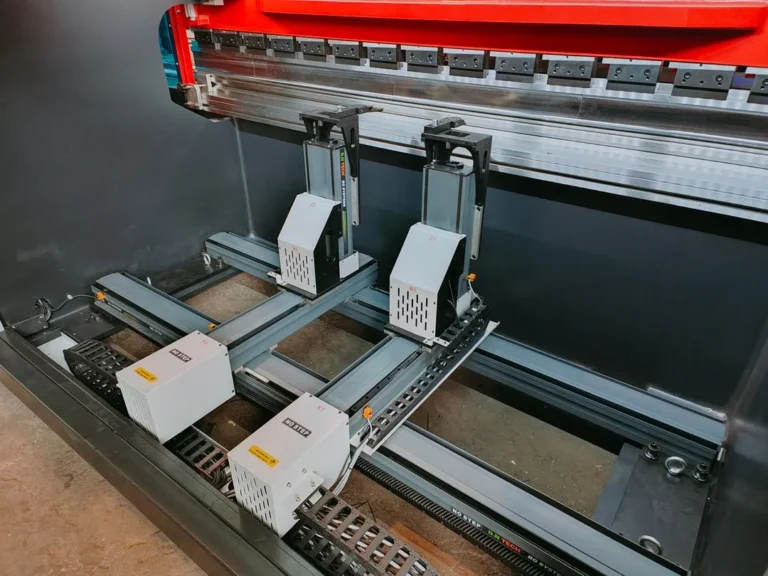
System 2 — 6-Axis Backgauge

6-Axis Systems — Total Independence & Maximum Capability

A 6-axis backgauge system provides fully independent movement for each finger across the X, R, and Z planes. This represents the pinnacle of industrial folding technology.

  • Elite Capabilities: Effortlessly handle highly complex, asymmetric parts and multi-step geometries that are impossible on standard systems.

  • Maximum Production Flexibility: Minimize downtime by allowing the machine to adapt to any part geometry without manual finger adjustment.

  • 3D CNC Integration: To fully unlock the potential of a 6-axis system, a high-end 3D CNC controller is essential. Only a 3D environment can visualize, calculate, and manage these advanced independent movements with micron-level accuracy.
Ready to Explore Upgrades for Your Machine?